Annie Nicholas writes paranormal and science fiction romance. Read about her hot vampire thrillers, werewolf romantic stories, alpha shifter and sexy alien romance.

Featured Post

Not His Werewolf Release Day!

Book 2 of Not This Series It's release day! After being disowned and labelled human because she can’t shift, Betty Newman rescu...

Monday, May 24, 2010

Punctuation by Caroline Adams

Punctuation is part of any serious writer’s craft. When used properly it helps guide your reader through your words, so they pause, stop, and start the way you meant your story to be read. Consider punctuation the roadmap for writing.


The following sentences provide guidance ‒pay attention not just to the words, but the punctuation as well‒on some of the things that punctuation can do:

Some punctuation can emit emotions: Excitement! Pondering?

Ellipses pause or dwindle off…

The em-dash stops abruptly‒

The semi-colon links two independent clauses together; as one, they create a deeper meaning than either statements does alone.

Commas segregates your phrasing, each special and unique, into readable components, which is especially vital in longer sentences, but never, under any conditions, allow a single comma to separate the subject from the verb, and don’t put a comma between two independent clauses; that’s semi-colon’s job.

The em-dash allows you to insert‒we all love to do this‒a totally independent thought into our sentence.

In summary, you have this great tool to guide the reader through your words: proper punctuation

Learn it; use it!

Now that I have you all excited to learn punctuation, let me throw in a caveat and my nomination for the stupidest punctuation rule of mankind.

While you would think punctuation rules should be black and white, not all of them are. I’ve no doubt someone will disagree with some of what I’ve written here. So my best advice is to pick a reliable source and stick to it. Personally, I try to follow The Chicago Manual of Style.

When you acquire an editor, they may go by a different standard, so you might need to tweak a few things. However, editors are aware of the ‘grey areas’ and a difference in usage will not bring shame upon you and your children. However, using blatantly wrong punctuation shows you have failed to learn an important tool of your trade.

Grey areas aside, English and American punctuation do have some differences. So make sure you learn the punctuation of the country where you plan to publish.

Now to the most illogical rule known to mankind: The Crappy Printer/Fragile Punctuation Rule.

That may not be its real title, but it should be!

The story concocted to explain our stupid rule is as follows: Long ago, our first printing equipment was, to be blunt, shoddy. Thus, the publishers made a change to the English punctuation rules to solve a printing problem they were having.

“Fragile punctuation will always be on the inside of any ‘quote marks,’” declared the grumpy printer, tired of fighting with a tiny half-blocks at the end of the sentence.

“But what if it’s an ‘internal quote’ that logically should be inside the sentence?” his apprentice asked.

“I don’t care if it’s an ‘internal quote,’” the grumpy printer replied. “If it ends in a period or comma, put those quote marks on the outside!”

“But if the sentence ends in an exclamation point or question mark then I can use ‘logical punctuation’?”

“Yes!”

The apprentice rubbed his temples, feeling the anger of centuries of writers bearing down upon him. “So we will not just be illogical, but inconsistent in the way we treat the’ internal quote’?”

“Yes. I’m just making this change so I can print using this crappy machine. Logic and consistency be damned!”

And while the printer’s life improved, American writers have been pulling out their hair ever sense.

Which leaves me to ponder why, in our digital age, where nary a half-block can be found, does this illogical fragile punctuation rule still exists? And when will the madness stop?


BLURB:

Aaron de Coeur arrives at his father, the Marquis’ deathbed to hear his father’s confession that he had married a sixteen year old English heiress five years prior to get himself out of debt. The young woman was allowed to remain in England and shockingly opened a ‘gentleman’s club’ becoming the mistress for half the men of society. The Marquis holds himself responsible for ‘stealing her life’ and begs his son to honor the promises he made to the girl. Aaron gives his word, but upon investigation discovers that matters are not as they seem.
 Buy now


BLURB:
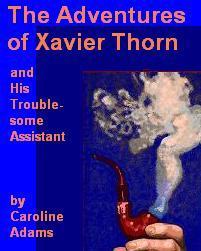
While investigating the death of a friend and client, Maddy Hamilton, Xavier Thorn (reputed to be the inspiration of Doyle’s Sherlock Holmes) is greatly impressed with Maddy’s nephew, Victor, and offers him a job as his secretary. Aware of Xavier’s history of firing secretaries, Victor garners a promise that he cannot be fired for three months and then proceeds, in Xavier’s view, to be cheeky and impertinent at every turn. Xavier endures ‘the impudent pup’ because Victor is most skilled in extracting the truth from clients and intuiting facts with little evidence to assist. As they solve a string of cases, Xavier discovers a few more important details about his troublesome assistant, such as her true gender, and the realization that she has awakened his long dormant heart.

Buy Now

Monday, May 17, 2010

Sentence Structures by a Dummy

When I refer to a dummy, I mean me. Like I stated in my first post, I don’t have any education in grammar, barely passed it in school, so if you’ve come here to be enlightened by big words describing each aspect to a sentence. Stop here.

I know a sentence starts with a capital letter, ends with a punctuation mark, has a noun, and a verb. There’s more to it than just that but I don’t think I need to know more. If you can’t wrap your mind around all the rules of the English language don’t sweat it. Try to write anyway.

What I do stress is to read and re-read your favorite books. Not for enjoyment but for study. Read what you liked the most and figure out why you like it so much. Pick out your favorite scene and dissect it. How did the writer use words to make it touch you?

Words are like music, they have a beat. When you watch an action movie the notes are fast and strong or a love scene can be lyrical and slow. How you construct your sentences affects the reader. Short to the point sentences can be used in high stress situations in writing, just like longer more poetic ones can be used to slow the mood in a story. The following example is an action scene. I’ve highlighted the short sentence to show the higher ratio.


            Ex: Rurik carried me back toward the wall. I could see Dragos' thugs fighting. A glimpse of a tall man with short, blonde hair in army fatigues between these warriors caught my breath. Colby was about to get creamed.


The smash of glass breaking made me twist around. Rurik had broken one of the small windows. He cleared the big shards away with his hands and winced as they cut through his skin. They barely even bled. He lifted me up to the hole, shoved me through it, then shouted, “Run, Rabbit, run!” A hard slap landed on my rump and pushed me through the rest of the way through the window. It stung.


The beat is made faster by the short sentences. It gives a sense of urgency and anxiety to the reader. This technique should not be used all the time, only in plot defining scenes, like this one where the story takes an unexpected twist. You will also notice I dispersed a long sentence in between these short beats. I call this a ‘take a breather’ sentence. If you have too many short beats in a row it sounds too desperate, like a racing heart, and not a good read.

Which brings me to my next point, don’t write boring. How is sentence structure connected to all of this? It’s everything. Readers need variety. Not just in characters and story but sentence structure too. Let me bring your attention to the red sentence above. I could have made all those sections short beats instead.


He lifted me up to the hole. He shoved me through it. He then shouted, “Run, Rabbit, run!”


How boring. It would have followed my short beat rules for action but it gave three similar sentence structures in a row, which is why I switched it. How can you tell what to do and when? Read it out loud. Listen to rhythm of the words.

Here are some quick simple rules to keep the reader’s interest. Don’t start following sentences with the same word or structure.


Bad ex: She walked to her desk and picked up a notebook. She wrote his phone number down.

Better ex: She walked to her desk and picked up a notebook. With a crayon, she wrote his phone number down.

Or: She walked to her desk and picked up a notebook. Writing his phone number down, she noticed her hand shook.


You’ll notice I’ve followed these same rules throughout this blog. Same goes with paragraphs, don’t use the same word or sentence structure to start succinct paragraphs.

Another rule, which I think most authors would agree with me, is EVERYTHING in moderation. It’s okay to use a LITTLE adverbs and –ing verbs, like the above example.

Try to start each sentence with an interesting word, be it verb or now. You won’t be able to do all of them but those that you can, then should be. Vary the, a, with, it, and pronouns starting sentences. I’ll use the same example from above.


EX: He carried me back toward the wall. I could see Dragos' thugs fighting. A glimpse of a tall man with short, blonde hair in army fatigues between these warriors caught my breath. Colby was about to get creamed.

The smash of glass breaking made me twist around. Rurik had broken one of the small windows. He cleared the big shards away with his hands and winced as they cut through his skin. They barely even bled. He lifted me up to the hole, shoved me through it, then shouted, “Run, Rabbit, run!” A hard slap landed on my rump and pushed me through the rest of the way through the window. It stung.


Each sentence started differently.

I hope this blog helped and didn’t make you more confused with my music analogy. It’s difficult to teach and learn this part of writing. This is one of the first steps of how to grip a reader’s attention. Like I mentioned before, re-read your favorite parts in books and examine the technique used.

Any questions?

Monday, May 10, 2010

Writing 101

To start, let me express how I do NOT consider myself an expert. I don’t have any degrees in English or Writing and have just started my career as a published author. The point of this blog, and the series to follow, is to impart what I do know.

I write paranormal and sci-fi romances so my focus will be toward the romance genre but I don’t see why it can’t be used for other types of stories.

I remember when I first started to take my writing seriously and didn’t have a clue where to start, what questions to ask, and who to ask them. Stumbling over my mistakes, going from different forums, yahoo groups, and websites I found what I needed but it sure wasn’t easy.

As I write each blog, I will return and edit previous blogs to provide links, which are in lime green so click on thes for more info. These will be the topics I’ll be discussing, one for each week:


- Show vs Tell

-POV  (point of views)


-Catching the Editor/Agents Attention (first line, query, and synopsis)

-How to submit *whip*

-Plotting

-Character development

I may add to this list and some of these will be written by guest bloggers because I still struggle with a few. *cough punctuation cough*

For any aspiring author reading this, welcome to the beginning of your journey. The first and most difficult thing any writer has to overcome is allowing a stranger to read their story. It’s a window to a piece of your soul and it’s hard to hear it’s not perfect. No one can help with this part but know you gotta do it at some point if you want to get published.

Here is a list of writing forums that I’m aware of. There might be more and I’ll add them to my list as I come across them.

1. Romance Divas

2. Absolute Write Water Cooler

3.Gather the Forum

You can lurk and read what info you need at these places or take a grand step and introduce yourself. These are great places to meet like minded people, talk shop, goof off, and learn.

Here’s a list of critique groups:


D. ERA

You can also acquire critique partners at the forums I mentioned above.

So this is the first step. Start sharing and don’t let anyone discourage you. There’s no such thing as a bad writer, only an inexperienced one. If you want to add information to these list just leave it in a comment with a link. Got a question? Ask away, there is no such thing as stupid question either.

Sunday, May 2, 2010

My Romance Times Adventure


J Hali Steele at EC party

Me with EC's Cavemen

Winner of Fairy Ball contes


Paranormal Romantics RT club table


The gift basket we gave away at RT club

Three of the Mr. Romance contestants. The one
on the right is Jamie and he won. :)

Me at the Book Expo having a great time.

Monday, April 26, 2010

Wicked Wednesday

Brought to you by Nico Calin. *la sigh*

I'm usually not attracted men with  facial hair but Nico pulls it off.

I don't know much about him, I'm terrible at research but from the little I found he's 33, a Capricorn, and his status is a swinger.

As a paranormal writer I can't help think vampire when I see his photos which is one of the many reasons why I'm sharing these with you today.

Have a wonderful day!


Thursday, April 15, 2010

I'm Going To Be A Fairy

On April 28th I'm going to turn into a fairy. I'll be going to the Romantic Times convention in Columbus Ohio at the end of the month. I'm so excited to be attending. In the May issue of their magazine my book Bait got a great review and got 4 stars. I can't wait to get my copy. The fairy ball being held will have an element theme this year. My mother came down from Canada this weekend to help me make this beautiful costume.


I was thinking I can either be sunlight an air fairy or copper an earth fairy. What do you think?

Wednesday, April 7, 2010

The Loyal Wife


There was a man who had worked all of his life, had saved all of his money,
and was a real misery when it came to his money.

Just before he died, he said to his wife, "When I die, I want you to
take all my money and put it in the casket with me. I want to take my money
to the afterlife with me."


And so he got his wife to promise him with all of her heart that when he
died, she would put all of the money in the casket with him.


Well, he died.


He was stretched out in the casket, his wife was sitting there in black,
and her friend was sitting next to her. When they finished the ceremony,
just before the undertakers got ready to close the casket, the wife said,


"Wait just a minute!"

She had a box with her, she came over with the box and put it in the
casket. Then the undertakers locked the casket down, and they rolled it away.


Her friend said, "I know you weren't fool enough to put all that money
in there with your husband."

The loyal wife replied "Listen, I'm a Christian, I can't go back on my
word. I promised him that I was going to put that money in that casket with
him."

"You mean to tell me you put that money in the casket with him!!!!?"

"I sure did" said the wife. "I got it all together, put it into my
account and wrote him a cheque. If he can cash it, he can spend it."


I love it when people are smart. :)